

What do they already have?
Spreadsheets, submitted forms, customer or participant records, communication preferences, and text or email services.
Business Orchestration · Customer and program communication
From scattered updates to communication people can act on.
Spreadsheets, forms, and contact records already contain what a team needs to communicate. Relay illustrates how DAT could use AI to help turn those outputs into personalized drafts, coordinated review, and an owned follow-up queue.
Spreadsheets, submitted forms, customer or participant records, communication preferences, and text or email services.
Staff repeatedly clean lists, copy details into messages, chase approvals, and lose track of who owns the next reply.
A connected review experience: checked source data, AI-assisted message drafts, human approval, and a shared view of follow-up.
Less manual preparation and fewer disconnected handoffs. Recipients get clearer updates, while staff can see what needs attention next.
The example starts with an existing spreadsheet. Reviewed messages would use the team’s existing or chosen text and email providers; customer records remain in their source systems.
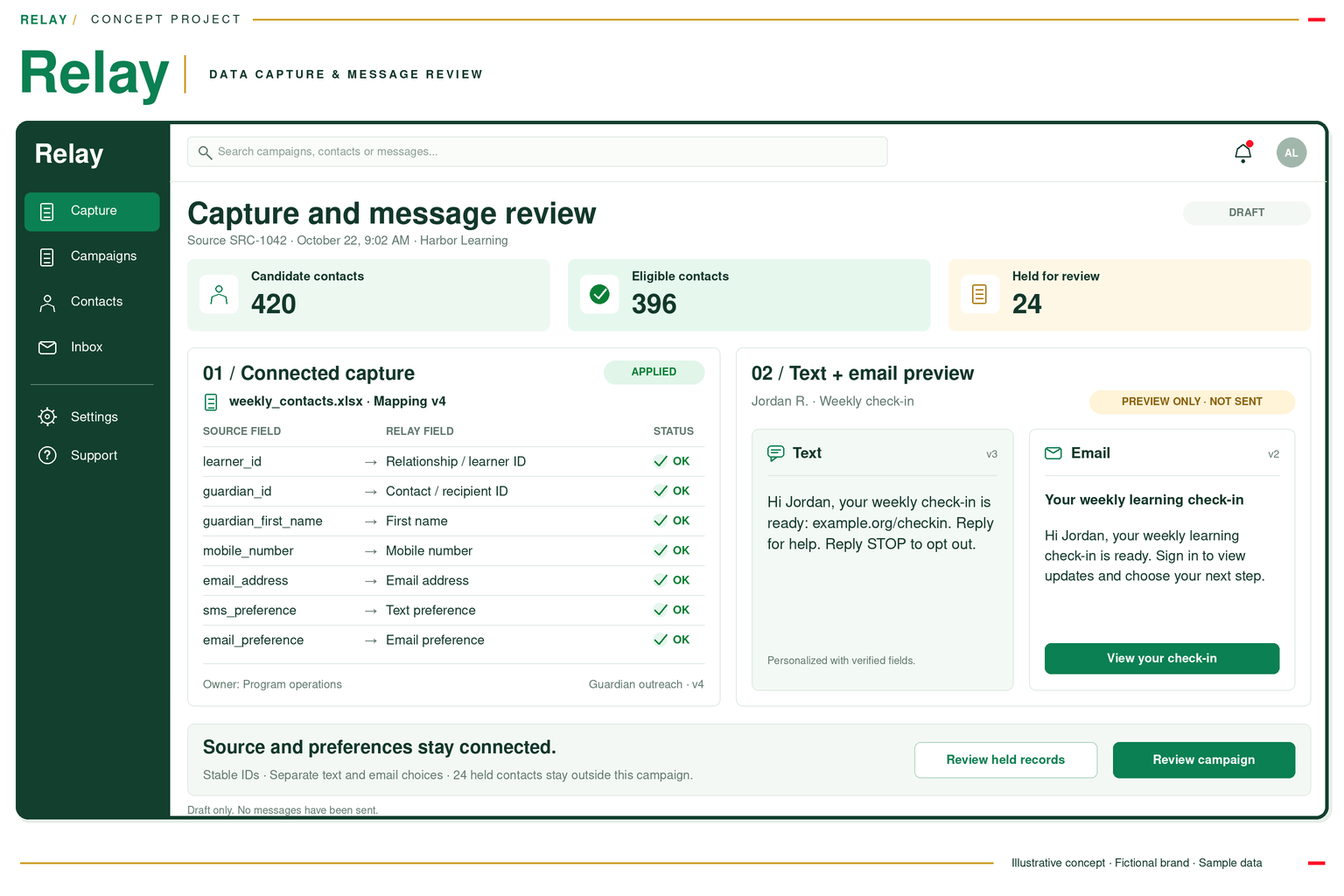
Concept screenshots with fictional data. These are visual demonstrations, not live applications.
Follow the proposed workflow, explore the assumptions, or see what a focused first step could involve.
Bring existing files, form responses, or agreed record exports into saved mappings for identity and channel preferences.
Reuse the information the team already has.
Apply explicit eligibility and preference rules. Hold uncertain identities or relationships for review.
Keep unresolved records out of the send.
Use verified values and AI-assisted drafting to prepare messages. A person checks the wording and each preview against the source.
Reduce repetitive preparation while keeping facts accountable.
Review the audience, message versions, and timing together. Record the approver before any release.
Make the decision and its owner visible.
Hand approved messages to existing or chosen providers and keep each channel’s reported status separate.
Distinguish handoff, delivery, and reading.
Bring replies, delivery issues, and unresolved exceptions into a queue with a responsible person and next action.
Keep the conversation connected to its context.
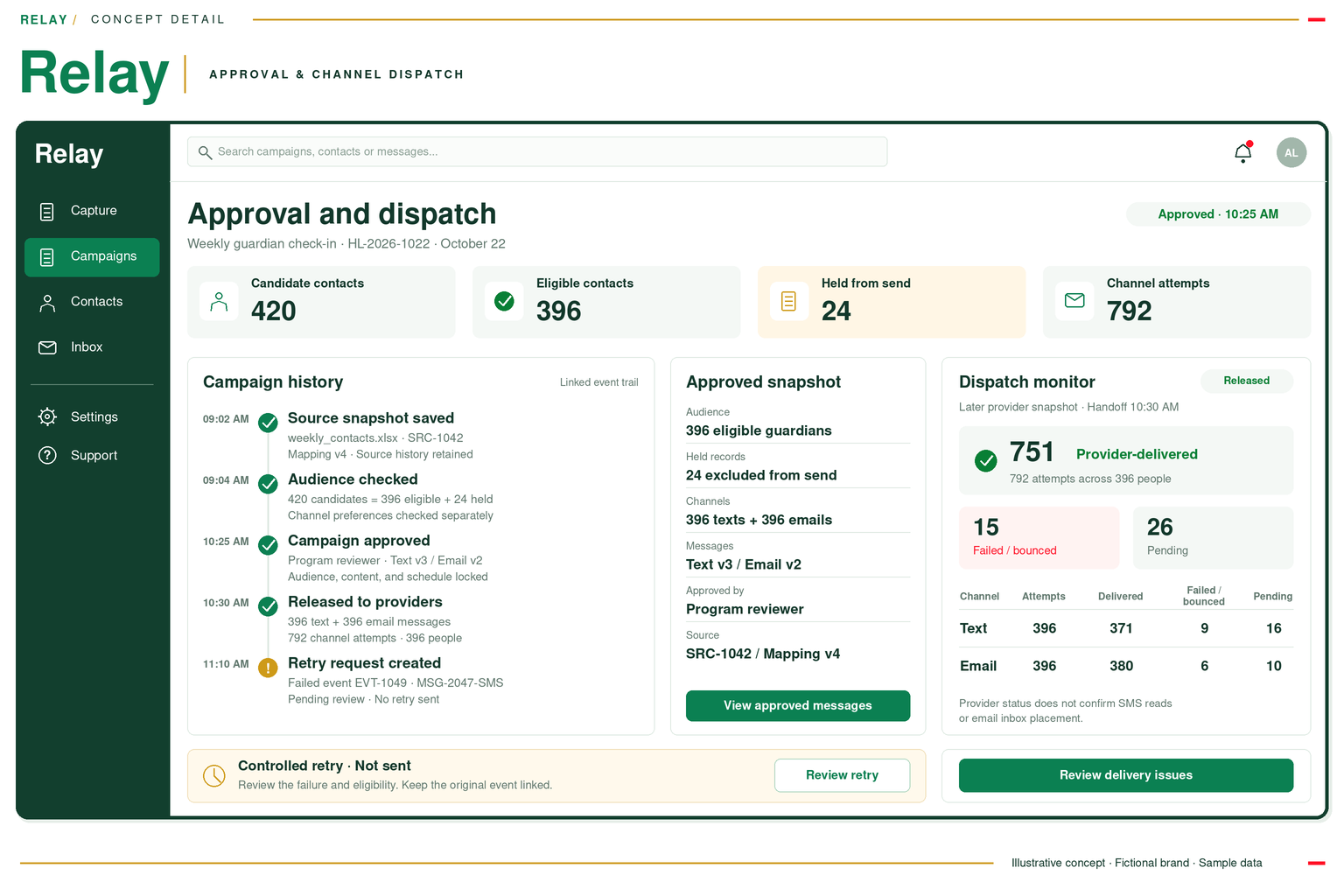
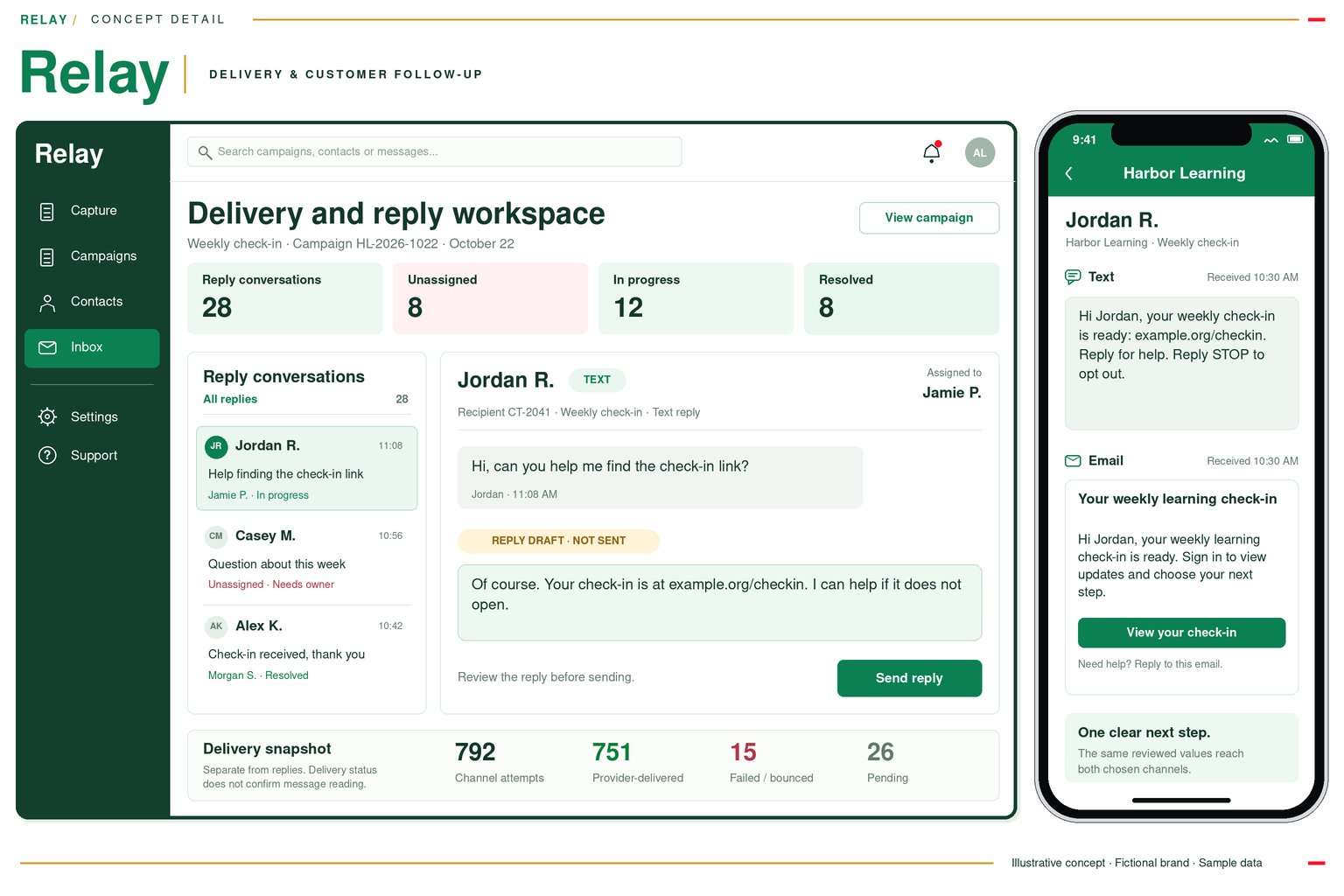
The fictional cohort contains 420 candidate contacts: 396 eligible and 24 held. Every eligible contact selected both channels, creating 396 texts and 396 emails. These 792 messages represent 396 people, not 792 recipients.
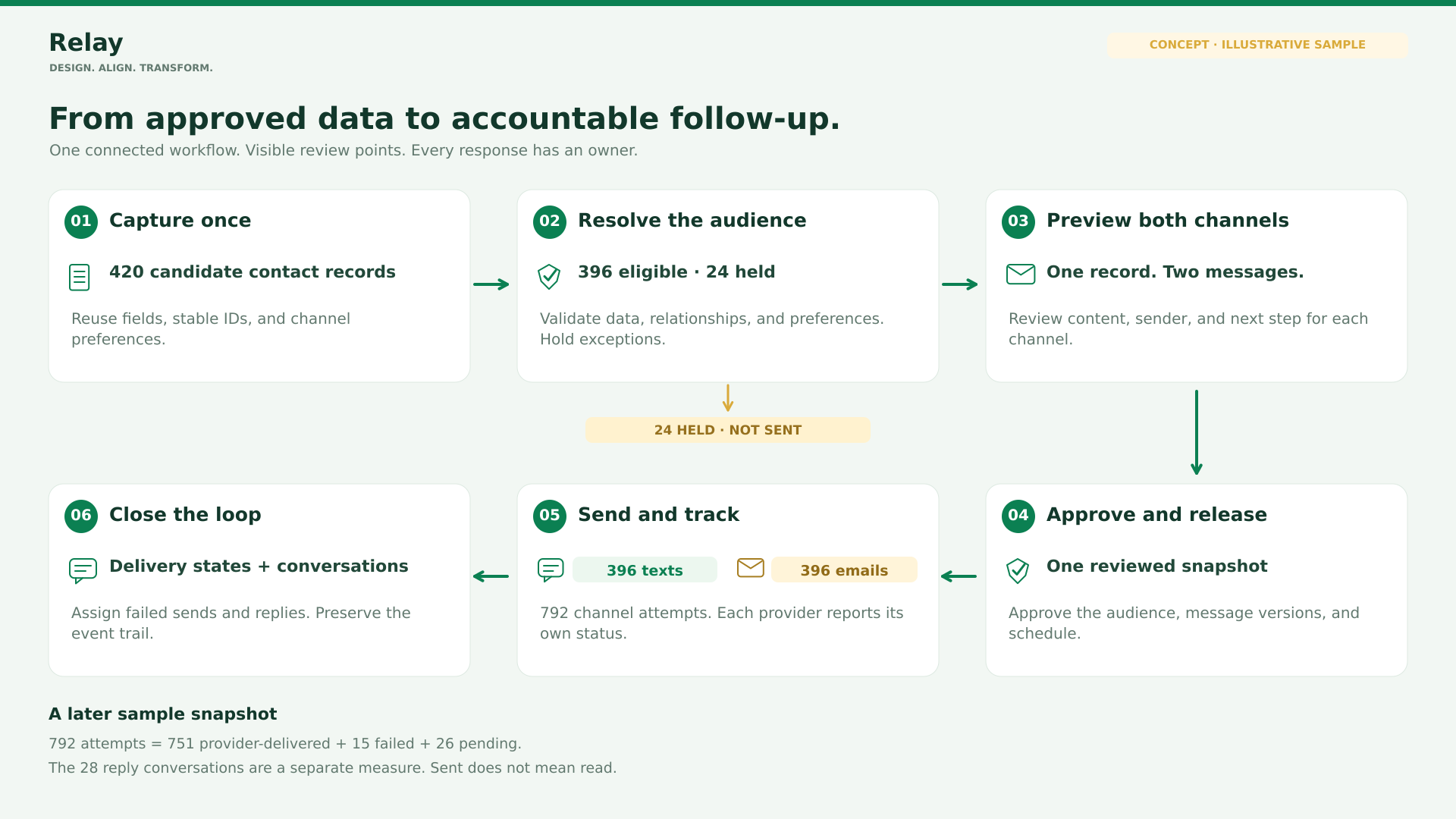
Your spreadsheets, forms, CRM or program records remain the sources. Your existing or chosen text and email services deliver the messages.
Bring source checks, message previews, approval, and follow-up together so staff can move from information to a clear next action.
Draft wording from approved facts and templates, and summarize follow-up context. Deterministic checks and human review control eligibility and release.
Start with an agreed export or form output. Use approved provider interfaces for sending and status; define permissions and ownership before adding any writeback.
AI assistance is proposed as part of these concepts. Source checks, explicit rules, and human approval remain essential before information is acted on or sent.
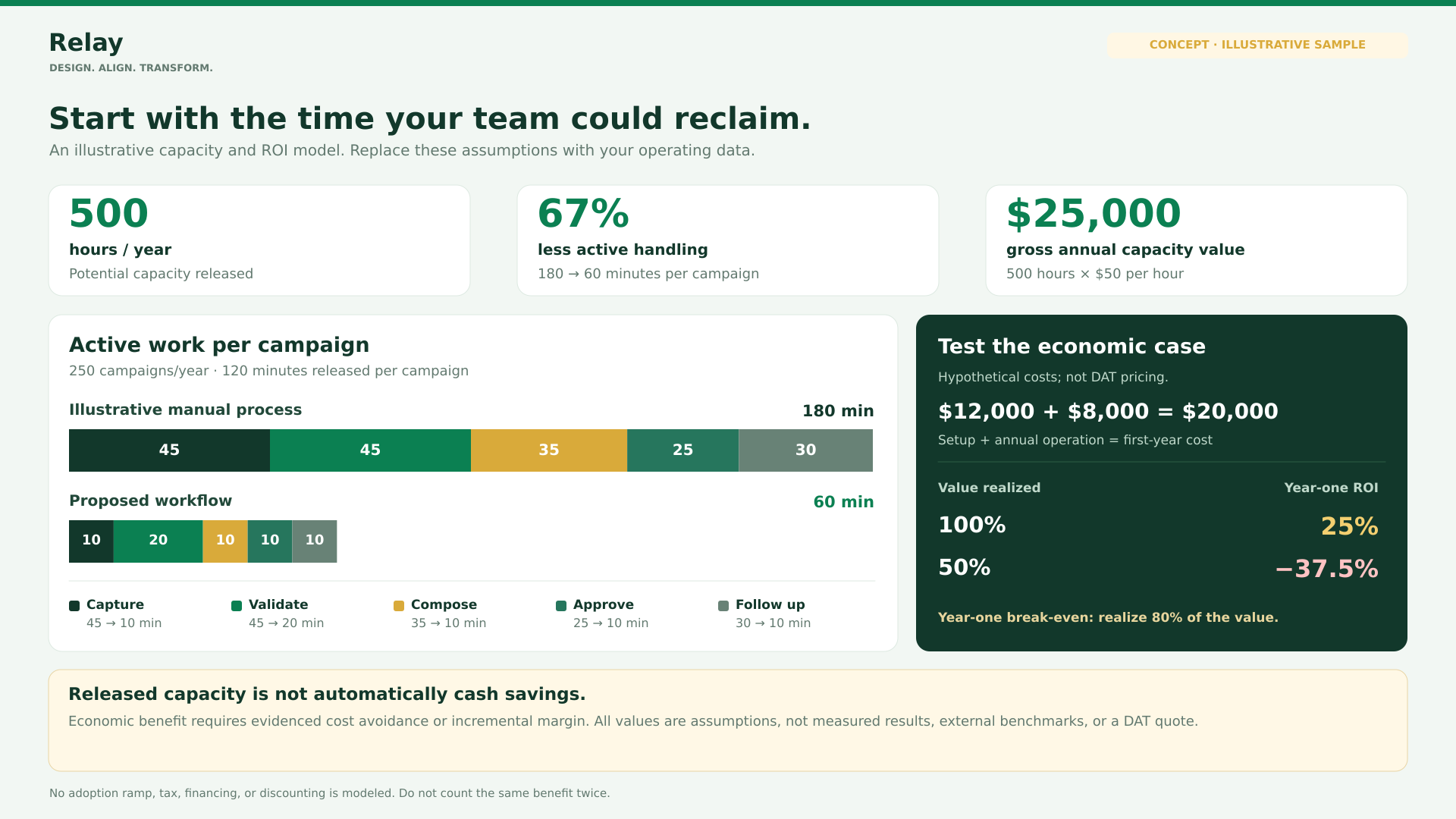
Adjust campaign volume, active handling time, hourly value, recognized value and costs to test the business case. The starting values are an example, not a forecast. Released capacity is shown separately from financial benefit.
Illustrative scenario. Example costs are model inputs, not DAT prices or a quote. Recognized benefit means evidenced avoided expenditure or incremental contribution after its relevant variable costs, before the project costs entered here. Useful redeployment by itself is capacity, not cash savings.
Recognized net benefit divided by total first-year cost
| Measure | Modeled | 50% of modeled benefit |
|---|---|---|
| Annual recognized benefit | $25,000 | $12,500 |
| Year-one cost | $20,000 | $20,000 |
| Net benefit | $5,000 | -$7,500 |
| ROI | 25% | -37.5% |
| Payback | 8.5 months | 32 months |
250 campaigns × (180 − 60) minutes ÷ 60 = 500 hours/year of potential capacity.
500 hours × $50/hour = $25,000/year of gross capacity value.
Assuming 100% value realization: $25,000 × 100% = $25,000 modeled annual financial benefit.
Year-one ROI = (recognized annual benefit − initial cost − annual operating cost) ÷ (initial cost + annual operating cost).
Simple payback in months = 12 × initial cost ÷ (recognized annual benefit − annual operating cost). No payback is shown when ongoing net benefit is zero or negative.
The example releases 500 hours a year and values that capacity at $25,000 before costs. With $20,000 of hypothetical first-year costs, recognized value must reach 80% of that capacity value to break even. At 50% realization, the example produces a $7,500 first-year loss and − 37.5% ROI. Validate comparable campaign workloads, exception effort and message quality before attaching financial value to a time reduction. The proposed application does not guarantee these improvements; source quality, adoption, provider behavior and evidence of realized benefit determine the result.
Bring us a repetitive task and the outputs your team already uses. We can explore a focused way to turn them into a more useful experience.